

Why Your Procurement Platform Is Still a System of Record — And What AI-Native Actually Means for Indian Manufacturing
Most companies are approaching AI in procurement the wrong way. They are adding AI tools. They should be redesigning the decision architecture itself.
Here is a number that should concern every procurement leader in Indian manufacturing: 95% of AI pilots fail to move beyond the proof-of-concept stage, according to research from MIT Sloan and McKinsey. That is not a failure of technology. It is a failure of architecture. Companies are bolting generic AI tools onto procurement platforms that were never designed to support intelligent decision-making. And then they wonder why the investment did not deliver.
The procurement technology landscape in India is at an inflection point. With 94% of procurement executives globally now using generative AI at least weekly — up 44 percentage points from 2023 — the question has shifted from “Should we adopt AI?” to something far more consequential: Are we building around the right architecture to make AI actually work?
The answer, for most Indian manufacturing companies running legacy e-procurement software or even modern source-to-pay platforms, is no. And the reason lies in a fundamental distinction that the industry has been slow to recognise.
Systems of Record vs. Systems of Decision: The Distinction That Changes Everything
For two decades, procurement automation in India has followed a familiar trajectory. Companies digitised their purchase requisitions. They moved RFQs online. They adopted e-auction platforms and vendor portals. They integrated these tools with their enterprise ERP systems for master data synchronisation and purchase order creation. And all of this was valuable — it created transparency, reduced manual effort, and built compliance frameworks.
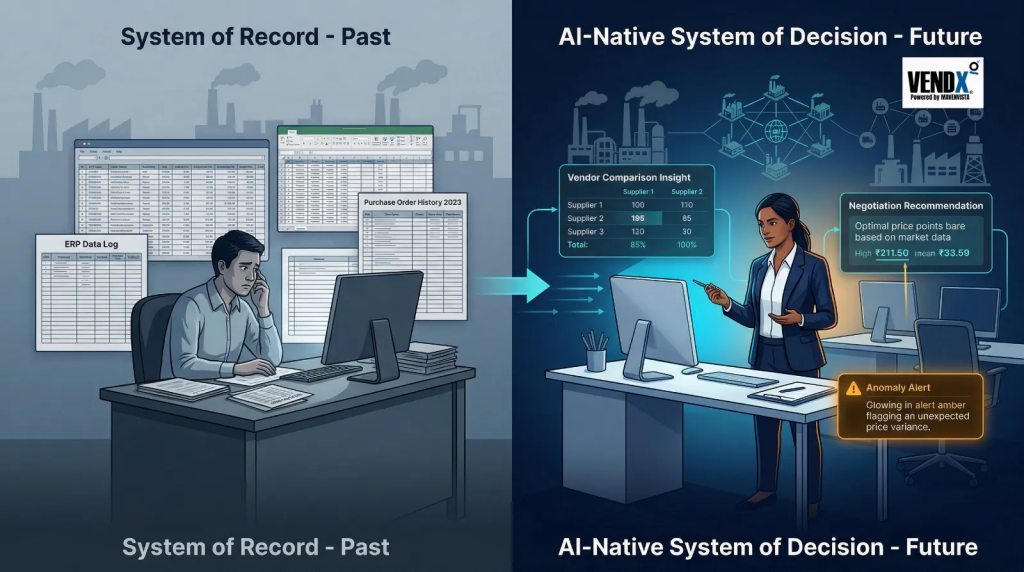
But here is the critical limitation: every one of these platforms was designed as a System of Record. Their primary function is to capture what happened — which vendor quoted what price, which approver signed off, which invoice was matched against which GRN. They are sophisticated digital filing cabinets for procurement transactions.
The future of procurement digital transformation belongs to something fundamentally different: Systems of Decision.
When intelligence is embedded directly into procurement workflows, the platform stops merely recording transactions and starts supporting decisions before they are made. That is the shift from automation to intelligence.
A System of Decision does not wait for a buyer to pull a spend report and then manually analyse vendor negotiation patterns. It surfaces those patterns — automatically, contextually, at the exact moment a new RFQ is being created. It does not require a procurement manager to remember that a particular vendor historically inflates first quotes by 12–15%. It tells the buyer, in real time, what the vendor’s negotiation behaviour looks like and recommends the optimal counter-strategy.
This is what AI-native procurement means. Not a chatbot sitting in a corner of your procurement portal. Not a dashboard that requires a data analyst to interpret. Intelligence embedded at every decision point across the entire source-to-pay lifecycle.
Why Generic AI Fails in Procurement — And What Domain-Specific Actually Looks Like
The 95% failure rate for AI pilots has a very specific cause that is particularly relevant for Indian manufacturing companies considering procurement analytics software.
Generic AI — a large language model connected to your database through an API — does not understand procurement. It does not know that in the Indian chemical industry, payment terms of 60 days versus 30 days on a ₹2 crore annual contract represent a working capital decision, not just a line item. It does not know that a vendor quoting 8% below the last authorised rate on a volatile commodity might be signalling distress rather than competitiveness. It does not know that the buyer at Plant A and the buyer at Plant B are purchasing the same material under different item codes at a 15% price differential.
Domain-specific AI knows all of this. But only if it has been built on the right foundation — years of actual procurement transaction data, vendor interaction patterns, negotiation histories, and industry-specific workflow knowledge.
This is why the approach of simply adding an AI layer on top of a legacy e-procurement system does not work. The AI has no procurement context. It has no understanding of category-specific negotiation dynamics. It cannot differentiate between a routine repeat purchase and a strategic sourcing event that requires completely different analytical frameworks. The result is generic recommendations that experienced procurement professionals immediately dismiss — and rightly so.
The AI-Native Approach: AI Agents Embedded in Procurement Workflows
An AI-native procurement platform is not one that has AI features. It is one where AI agents — purpose-built for specific procurement functions — are embedded directly into the workflow at the points where decisions are made.
Consider how this works in practice through what VENDX Genie has developed as specialised AI avatars for procurement — each designed for a distinct function within the source-to-pay process:
Notice the design philosophy here. Each AI avatar handles a specific, well-defined function — the repetitive, data-intensive tasks that machines genuinely handle better than humans. Strategic decisions, relationship management, and negotiation judgment remain firmly in human hands. This is not AI replacing procurement professionals. This is AI amplifying their capability at every workflow step.
Beyond Avatars: Robotic Process Automation for Procurement
Alongside the six AI avatars, an AI-native platform also deploys procurement automation through targeted RPAs that eliminate manual intervention in high-volume, rule-based processes:
Auto RFQ automatically generates and floats requests for quotation based on predefined rules — value thresholds, plant codes, quantities, and category-specific conditions. For tail spend and repetitive purchases, this means zero manual effort from the procurement team.
Hint/Auto Negotiation evaluates vendor quotes the moment they are submitted against historical benchmarks and configurable acceptable ranges. It displays a colour-coded signal to vendors — green, orange, or red — indicating how competitive their offer is. Vendors can choose to requote before formal negotiations even begin. This effectively enables 24/7 automated vendor negotiation, even outside business hours.
Together, these RPAs and AI avatars represent the operational reality of an AI-powered procurement intelligence platform — not a marketing promise, but a working system deployed across 75+ enterprise clients in Indian manufacturing.
The Indian Manufacturing Context: Why This Matters More Here
The argument for AI-native procurement software in India is even more compelling when you consider the specific challenges that Indian manufacturing companies face.
A typical large Indian manufacturer operates 15 to 60+ plants across multiple states, each with its own vendor ecosystem, regulatory requirements, and category dynamics. Procurement spend often ranges from 45% to 85% of revenue. The procurement team manages thousands of vendors across raw materials, packaging, MRO, logistics, CapEx, and services — each category with entirely different sourcing dynamics.
Global procurement platforms built for western enterprise workflows often struggle when deployed in Indian manufacturing environments. They consistently face adoption challenges. The numbers tell the story:
| Parameter | Global Platforms (Typical in India) | Domain-Specific AI-Native Platform |
|---|---|---|
| User Adoption Rate | < 25% | 92–95% |
| ERP Integration Success | Requires third-party SI | 100% in-house, single-point ownership |
| Implementation Speed | 6–18 months | Go-live in 24 working hours (Genie Packs) |
| Indian Workflow Customisation | Limited / Change request based | Pre-built for Indian manufacturing |
| AI Context | Generic / Global data models | 25 years of Indian procurement data |
| Vendor Training & Handholding | Vendor self-service | Dedicated support & training |
| Auction Strategies Available | 3–5 standard types | 140+ configurable strategies |
The adoption gap is the most telling metric. When a ₹40,000+ crore annual procurement operation runs at 92–95% platform adoption with 700+ active users across 60+ plants, it validates that the platform was designed for how Indian manufacturing procurement actually works — not how a global software vendor assumes it should work.
The Metadata Advantage: Why Starting Now Creates a Compounding Moat
Here is the strategic insight that most companies evaluating procurement software in India are missing entirely.
Every procurement decision — every RFQ issued, every negotiation conducted, every vendor evaluated, every auction strategy deployed — generates decision-making metadata. Which vendor was chosen and why. How the negotiation progressed. What the approval pattern looked like. How the actual delivery performance compared against the quoted terms.
On a System of Record, this metadata sits in disconnected tables across multiple modules. It is accessible only through manual reporting and after-the-fact analysis.
On a System of Decision, this metadata is the fuel for continuously improving AI intelligence. Every transaction makes the system smarter. Every negotiation teaches the AI more about vendor behaviour patterns. Every auction outcome refines the algorithm’s strategy recommendations.
Companies that begin capturing decision-making metadata today will have an insurmountable AI advantage in three years. This is not a technology choice. It is a competitive strategy decision with compounding returns.
This compounding effect is why timing matters. An organisation that starts building its procurement intelligence foundation today — with domain-specific AI that understands its categories, vendors, and workflow patterns — will have a fundamentally different analytical capability by 2029 than one that waits for the “next generation” of its current platform to add AI features.
What Proven Results Look Like: The Evidence from Indian Enterprises
The shift from Systems of Record to Systems of Decision is not theoretical. Across 75+ Indian manufacturing enterprises — spanning cement, pharmaceuticals, specialty chemicals, FMCG, engineering, automotive, and precision manufacturing — the AI-native approach has delivered measurable outcomes:
At the largest deployment — a ₹40,000+ crore annual procurement operation across 60+ manufacturing plants — the platform manages 55,000+ vendors with 700+ active users, achieving 97% SLA compliance and over ₹307 crore in documented auction savings over three years. The 320% growth in auction adoption volume at this single enterprise demonstrates what happens when the platform is genuinely built for the workflows it serves.
At a leading specialty chemical company, the AI-powered spend analysis capability identified pricing irregularities that manual processes had missed for years — flagging 15–20 pricing anomalies per quarter and enabling 2–3% additional margin protection on raw material procurement.
For a pharmaceutical manufacturer, meeting transcription and RFQ-linked audit trails eliminated 100% of audit observations related to inadequate decision documentation — a compliance outcome that no generic BI tool could have delivered.
The Question Every CPO Should Be Asking
If you are a Chief Procurement Officer, VP of Supply Chain, or Head of Sourcing at an Indian manufacturing company, the question is no longer whether to adopt AI in procurement. That debate is settled — 80% of CPOs globally plan to deploy generative AI over the next three years, and Indian manufacturers cannot afford to be in the remaining 20%.
The question is: Are you investing in a platform that treats AI as a feature — or one that was architecturally designed as a System of Decision from the ground up?
The difference will determine whether your AI investment compounds into a strategic advantage or becomes another expensive pilot that procurement professionals politely ignore.
For organisations that have spent decades building procurement expertise across complex Indian manufacturing supply chains — managing everything from volatile commodity pricing to multi-plant consolidation to vendor relationship dynamics that are unique to this market — the AI-native approach offers something no generic platform can: the ability to embed that institutional knowledge into an intelligent system that learns, adapts, and improves with every transaction.
That is the promise of AI-native procurement technology. Not AI as an add-on. AI as the architecture itself.
Ready to Move from Record-Keeping to Decision Intelligence?
See how VENDX Genie’s AI avatars and procurement intelligence packs can transform your sourcing operations — with go-live in 24 working hours.
Schedule a Consultation →